
BDO vs GBL: Key Differences in Chemical Properties and Uses
In the world of industrial chemicals, 1,4-butanediol (BDO) and gamma-butyrolactone (GBL) stand out as versatile intermediates essential to numerous manufacturing processes. These closely related compounds play critical roles in producing polymers, solvents, pharmaceuticals, and more. As the largest manufacturer of BDO and GBL, Universal Chemical Trading delivers high-purity products trusted by industries worldwide for consistent quality and reliability.
Understanding the BDO vs GBL differences helps manufacturers, researchers, and buyers select the right compound for specific applications. This post compares their chemical properties, structural relationships, industrial uses, and key considerations.
What Is 1,4-Butanediol (BDO)?
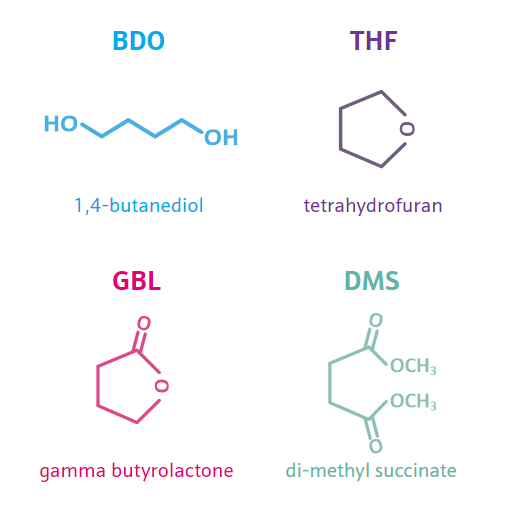
1,4-Butanediol, commonly abbreviated as BDO, is a linear diol with the chemical formula HO(CH₂)₄OH. It appears as a colorless, viscous liquid at room temperature, with a melting point around 20°C (causing it to solidify in cooler conditions) and a boiling point of approximately 230°C. BDO is miscible with water and many organic solvents, making it highly versatile.
As a primary alcohol, BDO serves primarily as a building block in polymer chemistry and as an intermediate for downstream products.
What Is Gamma-Butyrolactone (GBL)?
Gamma-butyrolactone (GBL) is a cyclic ester (lactone) with the formula C₄H₆O₂, structurally a five-membered ring featuring a carbonyl group. It is a colorless, hygroscopic liquid with a slightly higher density than water, a boiling point around 204°C, and excellent solubility in water and polar organics.
GBL is notably more lipophilic (fat-soluble) than related compounds, contributing to faster absorption in certain contexts, though its primary value lies in industrial solvency and reactivity.
Key Chemical Properties Comparison: BDO vs GBL
| Property | 1,4-Butanediol (BDO) | Gamma-Butyrolactone (GBL) |
|---|---|---|
| Chemical Formula | C₄H₁₀O₂ | C₄H₆O₂ |
| Structure | Linear diol (two -OH groups) | Cyclic lactone (ester ring) |
| Molecular Weight | 90.12 g/mol | 86.09 g/mol |
| Physical State | Colorless viscous liquid | Colorless hygroscopic liquid |
| Melting Point | ~20°C | ~-44°C |
| Boiling Point | ~230°C | ~204°C |
| Reactivity | Can undergo dehydration, oxidation, or polymerization | Ring-opening, hydrolysis, or hydrogenation reactions |
| Key Functional Groups | Primary alcohols | Lactone (cyclic ester) |
The most significant structural difference is that BDO is an open-chain diol, while GBL is its cyclic lactone form. BDO can be dehydrogenated to form GBL (often with high selectivity using copper-based catalysts), and GBL can be hydrogenated back to BDO in reversible processes, such as in liquid organic hydrogen carrier (LOHC) systems.
The Relationship Between BDO and GBL
BDO and GBL are interconvertible through redox reactions:
- Dehydrogenation of BDO yields GBL + H₂ (commonly catalyzed at elevated temperatures).
- Hydrogenation of GBL produces BDO (often using Cu-based or Co-based catalysts under pressure).
This close relationship allows flexible production, with BDO frequently serving as a precursor to GBL in industrial settings.
Industrial Uses of BDO
1,4-Butanediol is a high-volume commodity chemical with broad applications:
- Intermediate for polybutylene terephthalate (PBT), polybutylene succinate (PBS), and other engineering plastics.
- Production of tetrahydrofuran (THF), gamma-butyrolactone (GBL), and N-methylpyrrolidone (NMP).
- Synthesis of polyurethanes, elastomers, and polyether diols.
- Solvent and plasticizer in various formulations.
- Emerging role in biodegradable polymers and bio-based chemicals.
Global demand for BDO exceeds millions of tons annually, driven by plastics and automotive sectors.
Industrial Uses of GBL
Gamma-butyrolactone excels as a powerful solvent and intermediate:
- Precursor to N-methyl-2-pyrrolidone (NMP), widely used in lithium-ion battery manufacturing and electronics.
- Strong solvent for paint stripping, circuit board cleaning, and polymer processing.
- Intermediate in pharmaceuticals, herbicides, and agrochemicals.
- Production of pyrrolidones and other specialty chemicals.
GBL’s solvency properties make it indispensable in high-tech and electronics industries.
Why Choose High-Quality BDO and GBL from Universal Chemical Trading?
As the largest manufacturer of BDO and GBL, Universal Chemical Trading prioritizes purity, consistency, and compliance with international standards. Whether for polymer synthesis, solvent applications, or advanced chemical processes, sourcing from a leading producer ensures reliable supply and performance.
Conclusion: Selecting Between BDO and GBL
While BDO and GBL share a molecular backbone and interconversion pathway, their chemical properties dictate distinct roles: BDO as a versatile diol for polymerization and intermediates, and GBL as a reactive lactone prized for solvency and specialty chemical production. Understanding these BDO vs GBL differences enables optimized selection for industrial efficiency.
For premium-grade 1,4-butanediol and gamma-butyrolactone, contact Universal Chemical Trading at https://uctr-gmbh.de/ — the trusted leader in large-scale manufacturing.
BDO vs GBL, 1,4-butanediol vs gamma-butyrolactone, BDO chemical properties, GBL chemical properties, BDO uses, GBL uses, BDO GBL differences, gamma-butyrolactone production, 1,4-butanediol manufacturer, GBL solvent applications, BDO polymer intermediate, GBL NMP precursor, BDO GBL conversion, industrial uses BDO GBL, high purity BDO GBL,