
Gamma-Hydroxybutyrate (GHB) Synthesis: Lab Techniques Explained
Gamma-Hydroxybutyrate (GHB) Synthesis: Lab Techniques Explained
Gamma-Hydroxybutyrate () is a naturally occurring neurotransmitter and a polar solvent with significant applications in both biochemical research and industrial chemical synthesis. Understanding its production requires a firm grasp of organic chemistry, specifically the hydrolysis of lactones.
The Chemical Foundation of GHB
GHB is the conjugate acid of gamma-hydroxybutyrate. In industrial and laboratory settings, it is most commonly handled as a sodium salt (Sodium Oxybate) due to its increased stability compared to the free acid form.
The most efficient and widely utilized method for synthesizing GHB is the alkaline hydrolysis of Gamma-Butyrolactone (GBL).
The Synthesis Process: Step-by-Step
The reaction is a straightforward nucleophilic substitution where a strong base reacts with the lactone ring.
1. Reagent Preparation
The synthesis requires two primary precursors:
-
Gamma-Butyrolactone (GBL): A hygroscopic colorless liquid that serves as the cyclic ester precursor.
-
Sodium Hydroxide (NaOH): Or an equivalent alkali metal base (such as Potassium Hydroxide) to act as the nucleophile.
2. The Saponification Reaction
When GBL is added to a solution of Sodium Hydroxide, the hydroxide ion () attacks the carbonyl carbon of the GBL molecule. This process breaks the ester bond, opening the four-carbon ring to form the hydroxy acid salt.
3. Reflux and Titration
To ensure complete conversion, the mixture is typically heated under reflux. Precision is vital; the pH must be monitored closely. An ideal reaction reaches a neutral or slightly basic pH (approximately 7.0 to 8.0). If the solution remains too basic, it may require titration with a dilute acid to neutralize excess sodium hydroxide.
4. Dehydration and Solidification
The resulting solution is high in water content. To obtain a high-purity crystalline powder, the solution is heated to evaporate the solvent. Once the temperature reaches approximately 150°C, the molten salt can be poured and allowed to cool, resulting in a stable, anhydrous solid.
Quality Control in Industrial Manufacturing
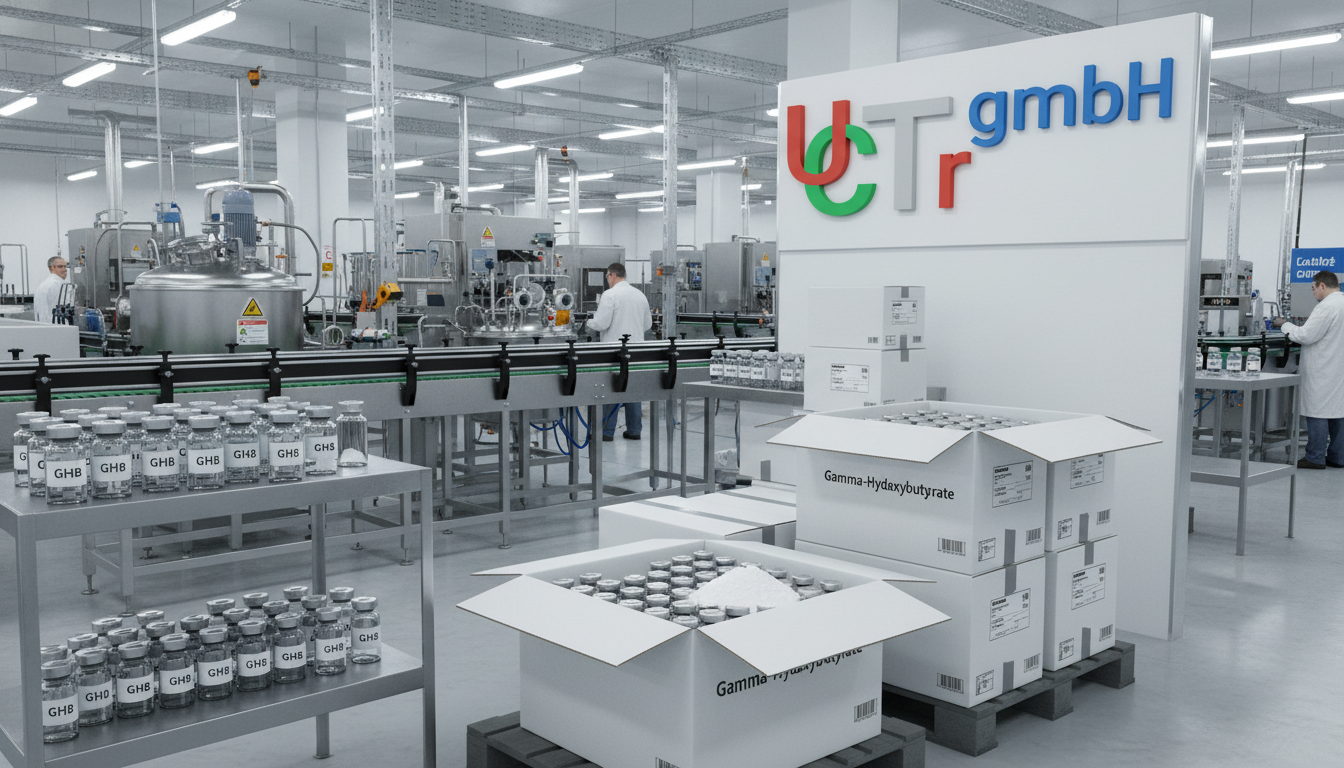
For high-scale production, maintaining the purity of precursors is essential. Impurities in GBL can lead to unwanted side reactions or a discolored final product. Leading manufacturers, such as Universal Chemical Trading, utilize advanced filtration and vacuum distillation techniques to ensure that the chemical integrity of the GHB meets rigorous laboratory standards.
Safety and Compliance
The synthesis of GHB involves exothermic reactions that generate significant heat. Laboratory environments must utilize specialized glassware, such as Borosilicate flasks, and proper thermal monitoring. Furthermore, as GHB is a regulated substance in many jurisdictions, all synthesis and trading must comply with local and international chemical control laws.
Gamma-Hydroxybutyrate synthesis,
GHB manufacturing process,
Gamma-Butyrolactone hydrolysis,
Sodium Oxybate production,
Industrial chemical synthesis,
GBL to GHB conversion,
Chemical precursors for GHB,
Universal Chemical Trading,
Organic chemistry lab techniques,
Alkaline hydrolysis of lactones,
GHB chemical properties,
Bulk chemical manufacturing,
Sodium Hydroxide reaction,
High-purity GHB,
Laboratory grade Gamma-Hydroxybutyrate,