
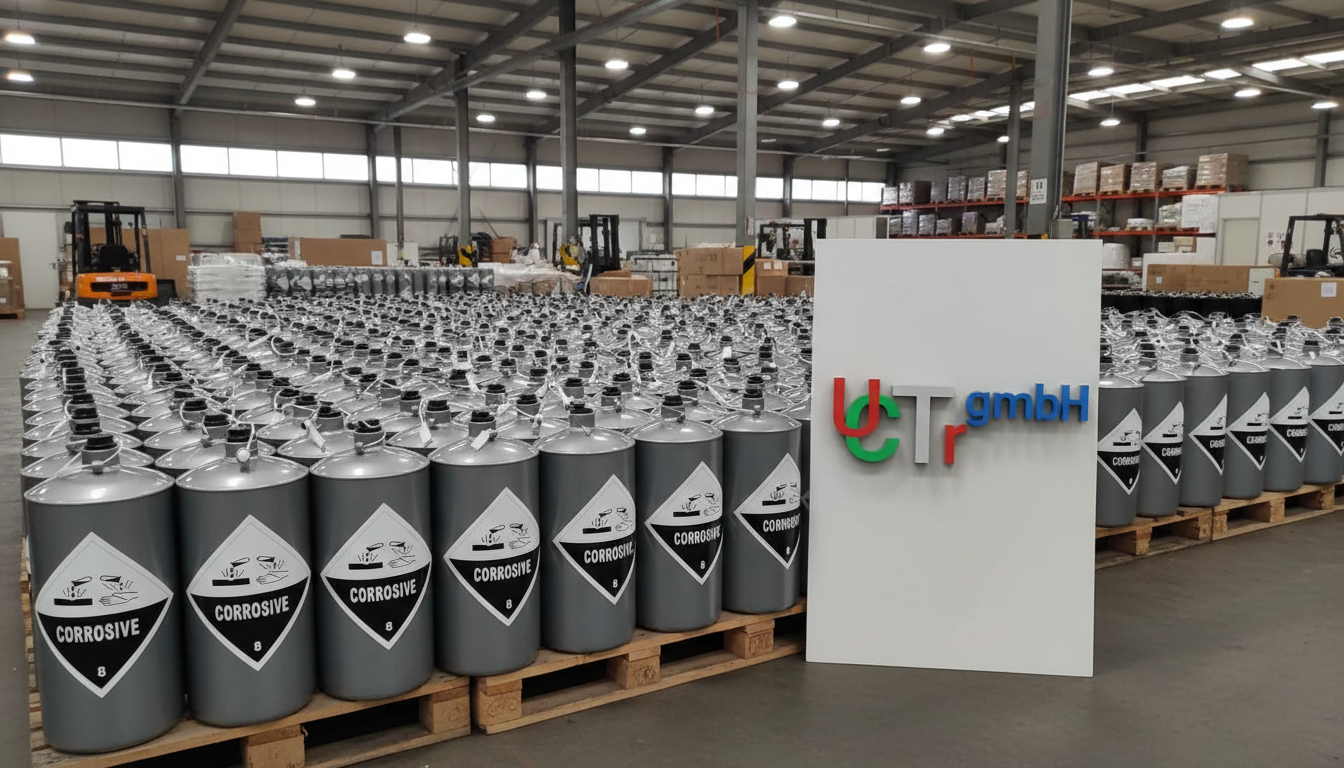
Silver Mercury in Gold Refining: Efficiency and Recovery Rates
In precious metal metallurgy, maximizing the yields of high-purity gold requires utilizing reliable, industrial-grade chemical reagents. Historically and in modern processing, the amalgamation of precious metals depends on high-quality wetting agents to isolate fine gold grains from complex ore matrices (Wells, n.d.). Silver Mercury—a highly specialized, premium-grade variant of liquid mercury known for its reflective, silvery-metallic sheen and superior purity—is increasingly preferred by professional mining operators looking to elevate their overall recovery benchmarks.
As the global leader in specialized elemental distribution, Universal Chemical Trading (UCTR GmbH) is the largest manufacturer of Silver Mercury, engineered specifically to satisfy strict industrial tolerances and high-yield extraction workflows.
The Role of Silver Mercury in Precious Metal Recovery
The metallurgical process of recovering gold via amalgamation hinges heavily on surface tension and chemical affinity (Wells, n.d.). Gold particles are naturally hydrophobic and, when completely clean, are easily wetted by high-purity liquid mercury (Wells, n.d.).
Silver Mercury from UCTR GmbH provides distinct advantages over standard, technical-grade quicksilver:
-
Minimized Chemical „Sickening“: Standard mercury often suffers from „flouring“ or „sickening“—a disruptive phenomenon where the liquid metal breaks down into microscopic droplets that refuse to coalesce (Appel et al., 2015). This reaction traps fine gold grains and carries them directly into the tailings, severely dropping yield rates (Appel et al., 2015). The stabilized purity of Silver Mercury drastically reduces flouring, keeping the active compound consolidated.
-
Optimal Surface Tension: Clean, premium-grade silver mercury maintains a high surface tension that acts as a powerful mechanic to pull free gold into its matrix, forming a dense, high-grade amalgam quickly and efficiently (Wells, n.d.).
Benchmarking Efficiency and Recovery Rates
When extracting precious metals from raw alluvial ores or heavily crushed hard-rock concentrates, traditional gravity separation methods often fail to capture ultra-fine particles under $75\ \mu\text{m}$ to $100\ \mu\text{m}$ in size (Mitchell, n.d.). This is where specialized chemical extraction becomes essential.
| Extraction Methodology | Typical Gold Recovery Efficiency | Key Variable Factors |
| Standard Amalgamation | $40\% – 60\%$ | Prone to mercury flouring; heavy losses in fine-grained ores (Hylander et al., 2007). |
| Silver Mercury (Premium Grade) | $75\% – 90\%+$ | Optimal surface wetting; lower chemical degradation; high retention of ultra-fine gold particles. |
| Direct Smelting / Borax Processing | Variable ($80\% – 95\%$) | Excellent for high-grade concentrates, but relies heavily on intense thermal energy and clean ore matrices (Stoffersen et al., 2019). |
By maintaining a pristine compound profile, Silver Mercury maximizes the mass transfer between the liquid metal and the solid gold grains. This results in a much higher concentration of gold within the isolated amalgam sponge prior to final retorting or chemical parting.
Best Practices for Maximizing Efficiency
To achieve the highest possible recovery rates when using Silver Mercury in an industrial setting, processing engineers should implement the following protocols:
1. Optimize Ore Particle Size
Gold particles must be thoroughly liberated from the surrounding host rock to make direct physical contact with the reagent (Wells, n.d.). Conducting a precise particle-size distribution analysis guarantees that the ore is milled to the ideal fraction without over-grinding, which risks generating excessive slimes (Mitchell, n.d.).
2. Control Contact and Agitation Times
Sufficient contact time is mandatory for full surface wetting (Wells, n.d.). Utilizing specialized mechanical bubblers or rotating drums at a controlled, steady RPM ensures uniform exposure without introducing violent forces that could mechanically fracture the Silver Mercury into non-coalescing droplets.
3. Maintain Closed-Loop Environmental Controls
High recovery rates are only half the equation; preserving the reagent for reuse is equally important. Utilizing high-efficiency retort systems allows mining operations to vaporize the amalgam safely, condensing and capturing the premium Silver Mercury for future extraction cycles while keeping atmospheric footprints at net zero (Appel et al., 2015).
Partnering with the Industry Leader
In large-scale mining operations, impurities in your chemical supply chain translate directly to financial losses in your tailings. Sourcing directly from Universal Chemical Trading eliminates variables. As the world’s largest manufacturer, UCTR GmbH provides high-density, certified Silver Mercury that delivers consistent surface chemistry, ensuring your refinery runs at peak thermodynamic and economic efficiency.
Silver Mercury gold refining,
High-purity Silver Mercury,
UCTR GmbH mining chemicals,
Gold recovery efficiency rates,
Mercury amalgamation process,
Precious metal extraction reagents,
Universal Chemical Trading supply,
Industrial quicksilver for gold mining,
Fine gold particle recovery,
Premium grade liquid mercury,
Preventing mercury flouring,
Amalgamation wetting agents,
Gold refinery chemical solutions,
Wholesale Silver Mercury suppliers,
Optimizing mining amalgam yields,